MOBI-TWIN Final Conference

Mobility, Regional Attractiveness and Cohesion in Europe’s Twin Transition

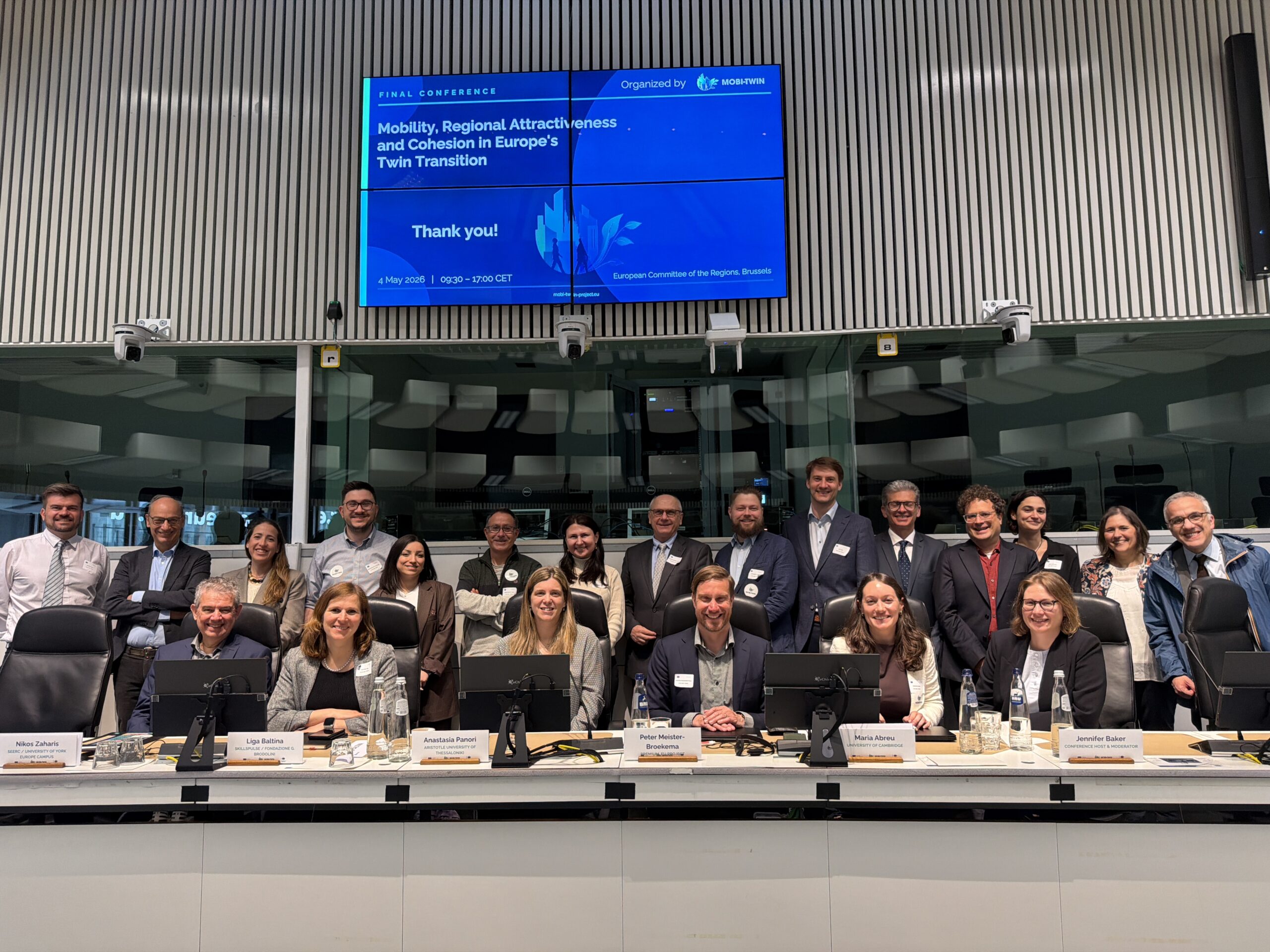
On 4 May 2026, the MOBI-TWIN project brought together policymakers, researchers and regional stakeholders at the European Committee of the Regions in Brussels to explore how Europe’s green and digital transitions are reshaping mobility and regional development.

4 May 2026 09:30 – 17:00 CET European Committee of the Regions, Brussels
Watch the Recording

How is the twin transition reshaping mobility across Europe?

How is the green and digital transition reshaping mobility patterns across Europe, and what does this mean for regions and their development prospects? The MOBI-TWIN Final Conference brought together policymakers, researchers and regional stakeholders to discuss how spatial mobility influences regional attractiveness, labour markets and territorial cohesion in the context of the twin transition.

Building on evidence from the Horizon Europe MOBI-TWIN project, the conference presented new insights on mobility drivers, emerging regional disparities and future scenarios. Particular attention was given to how different types of regions – including those facing population decline or talent outflows – are affected, and how these trends may reinforce or mitigate existing inequalities across Europe.

The conference also addressed policy implications at EU, national and regional level. Through discussions with representatives from EU institutions, regional authorities and related initiatives, participants explored how data, tools and evidence can support more effective and place-based policy responses.

Key Details

Date

Monday, 4 May 2026

Time

09:30 – 17:00 CET

Venue

European Committee of the Regions
Room VMA 21, Rue Van Maerlant
1040 Brussels, Belgium

Format

In-person conference
Keynotes, panels, policy debates & networking

What We Achieved

The MOBI-TWIN Final Conference marked the culmination of three years of research under the Horizon Europe programme. The event brought together over 20 speakers and panellists from universities, the European Commission, the OECD, regional authorities and sister EU projects to present and debate the project’s findings.

A central theme of the day was the geographical revolution unfolding across Europe: the digital transition is making location increasingly optional – you can work from a village, a coastal island, anywhere the fibre reaches – while the green transition is making location a matter of destiny, tied to where the wind blows and the sun falls. These two opposing forces are reshaping how and where people choose to live, and the conference explored what this means for regions across Europe.

Among the key outputs presented were:

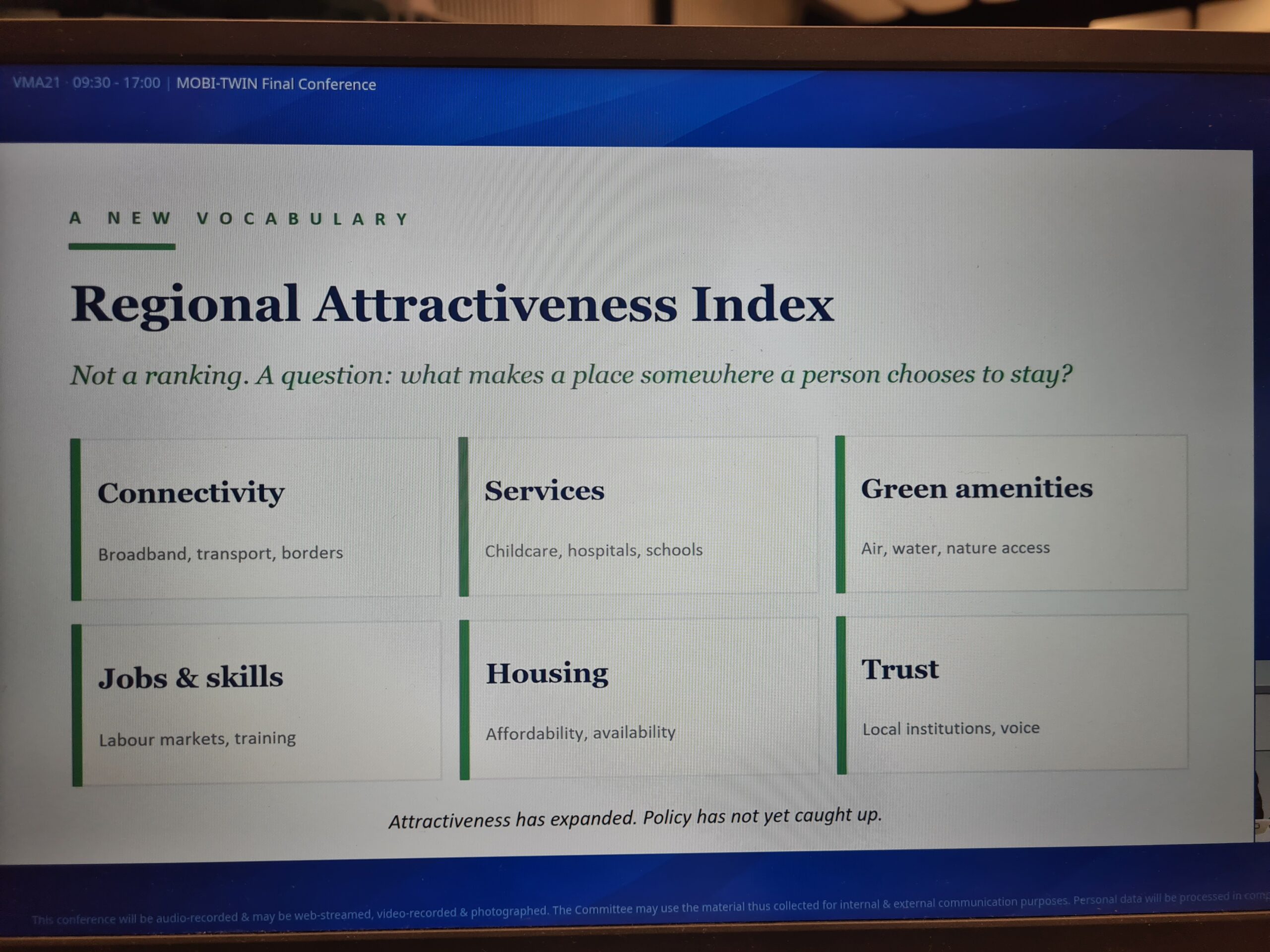
Regional Attractiveness Index

A new framework that goes beyond rankings to ask: what makes a place somewhere a person chooses to stay? Covering connectivity, services, green amenities, jobs & skills, housing and trust.

Integrated Mobility Datasets

Novel methods for mapping how people move across European regions, combining mobile phone data, transport records and survey data into a unified picture of spatial mobility.

Policy Dashboard & Briefs

An interactive policy intelligence tool and a series of policy briefs translating the project’s research into concrete, actionable recommendations for EU, national and regional policymakers.

Future Territorial Scenarios

Forward-looking models exploring how European regions may develop under different transition pathways, with particular attention to left-behind places and demographic change.

The afternoon sessions brought together lessons from sister Horizon Europe projects – PREMIUM_EU, R-Map and SkillsPulse – highlighting common patterns and complementary approaches to understanding Europe’s territorial challenges. The conference closed with a forward-looking keynote by Maria Abreu (University of Cambridge) on the future of place-based policy in the EU.

Watch the Full Conference

Missed the event or want to revisit a session? The full conference recording is available below, split into four parts.

Part 1: Opening Remarks, Keynote & Understanding Mobility DynamicsWelcome, opening keynote by Anastasia Panori, and scientific presentations by Olle Järv and Vicente Royuela
Part 2: From Evidence to Policy IntelligencePolicy panel debate with experts from the European Commission, OECD, ESF and ULB
Part 3: Future Scenarios & Left-Behind RegionsScientific presentations on modelling and policy panel on challenges facing vulnerable regions
Part 4: What Works? Lessons & ClosingCross-project session with PREMIUM_EU, R-Map and SkillsPulse, closing keynote by Maria Abreu

Conference Agenda

Full programme as delivered on 4 May 2026.

09:30 – 10:15
Registration & Welcome Coffee
10:15 – 10:30
Welcome & Opening Remarks
The MOBI-TWIN Final Conference kicked off with a welcome from project coordinator Giulia Zendron, setting the scene and framing the big question at the heart of the conference: how is Europe’s twin transition reshaping where people live, work, and move, and what does that mean for the future of our regions?
  • Conference hostJennifer Baker — EU policy and tech reporter
  • Thomas Wobben — Director of Legislative Works, European Committee of the Regions
  • Simone Rosini — European Commission, Directorate General for Employment, Social Affairs and Inclusion, Fair Green and Digital Transitions, Research Unit
  • Giulia Zendron — MOBI-TWIN Coordinator, Senior Project Manager at White Research
10:30 – 10:50
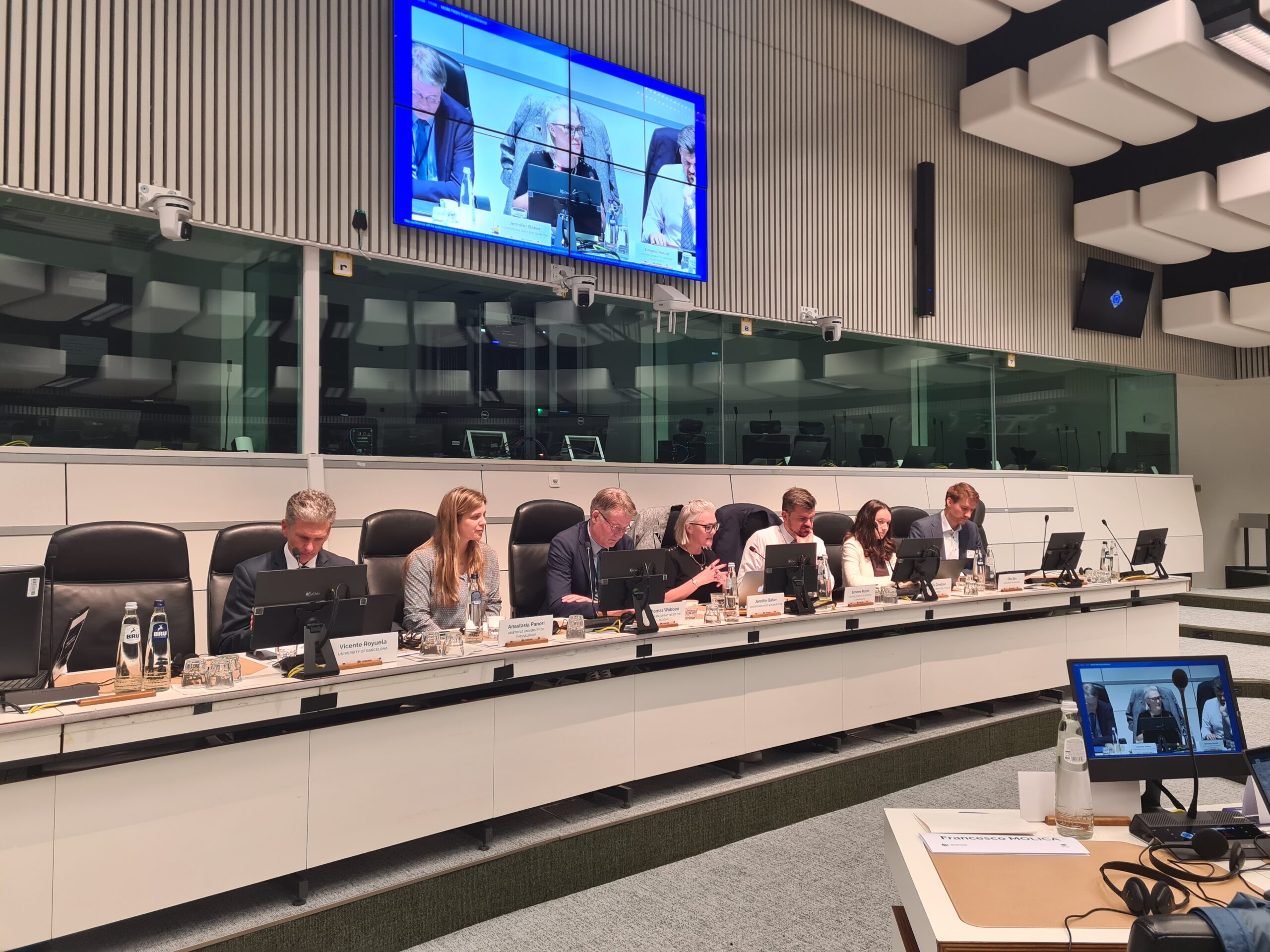
Mobility in Europe’s Twin Transition: Why mobility matters for regional cohesion now?
People are on the move, and not always in ways that benefit every region equally. In this opening keynote, MOBI-TWIN Scientific Coordinator Anastasia Panori sets the stage with a compelling case for why spatial mobility sits at the centre of Europe’s green and digital transitions and why getting policy right on this issue has never been more urgent.
  • KeynoteAnastasia Panori — MOBI-TWIN Scientific Coordinator, Assistant Professor on Regional Analysis and Policy, Aristotle University of Thessaloniki
10:50 – 11:40
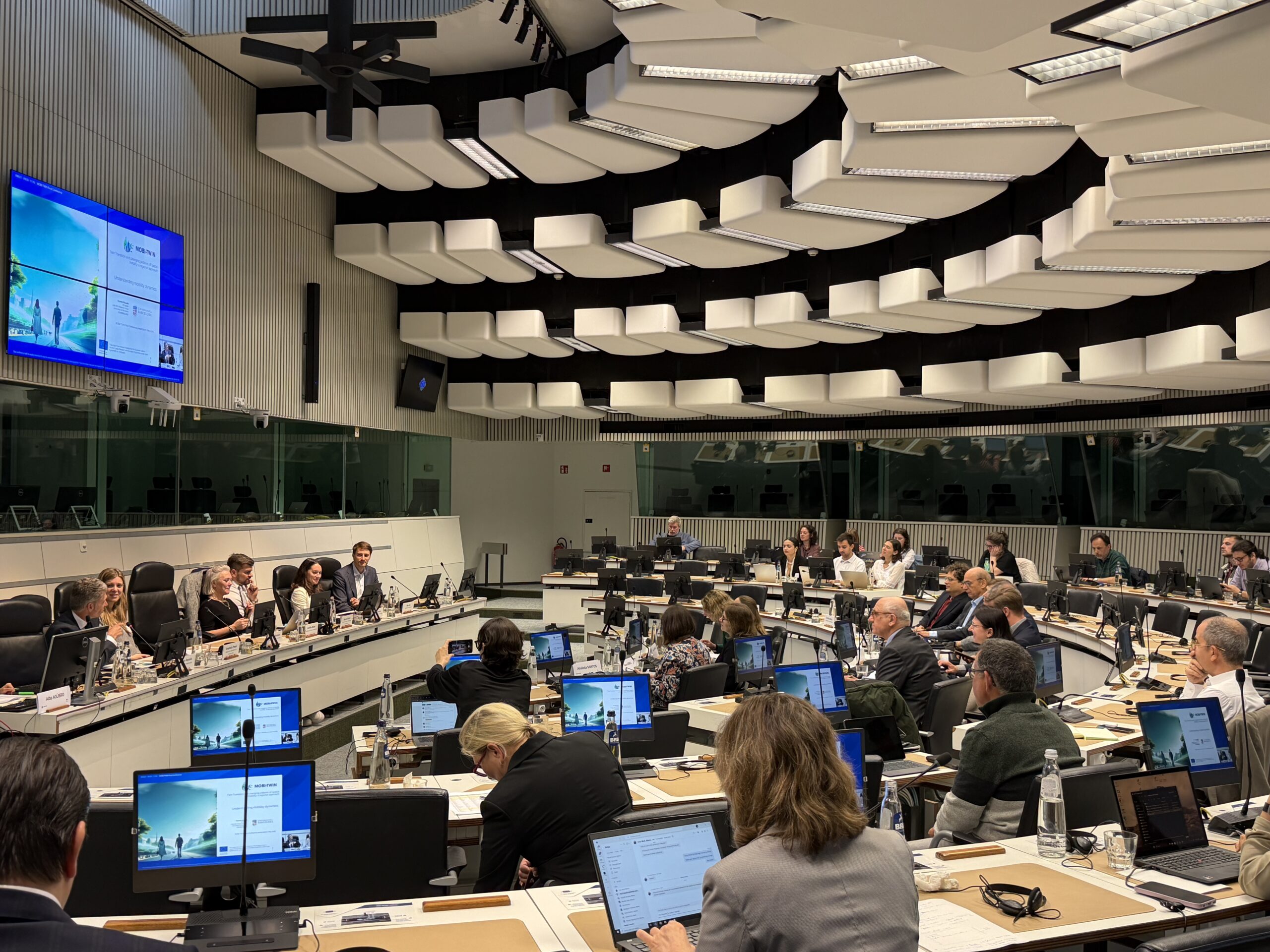
Understanding Mobility Dynamics
What does mobility across Europe actually look like, and what’s driving it? This session brought together two leading researchers presenting fresh evidence from the MOBI-TWIN project. From cutting-edge mobility mapping using integrated datasets to new analysis of what makes regions attractive (or not), this is where the data told its story.
  • Olle Järv — Researcher, Digital Geography Lab, University of Helsinki
    • Integrated datasets & Mobility mapping
  • Vicente Royuela — Full Professor of Applied Economics, University of Barcelona
    • Drivers of Mobility & Regional Attractiveness

Followed by Q&A with the audience

11:40 – 12:00
Coffee Break
12:00 – 13:00
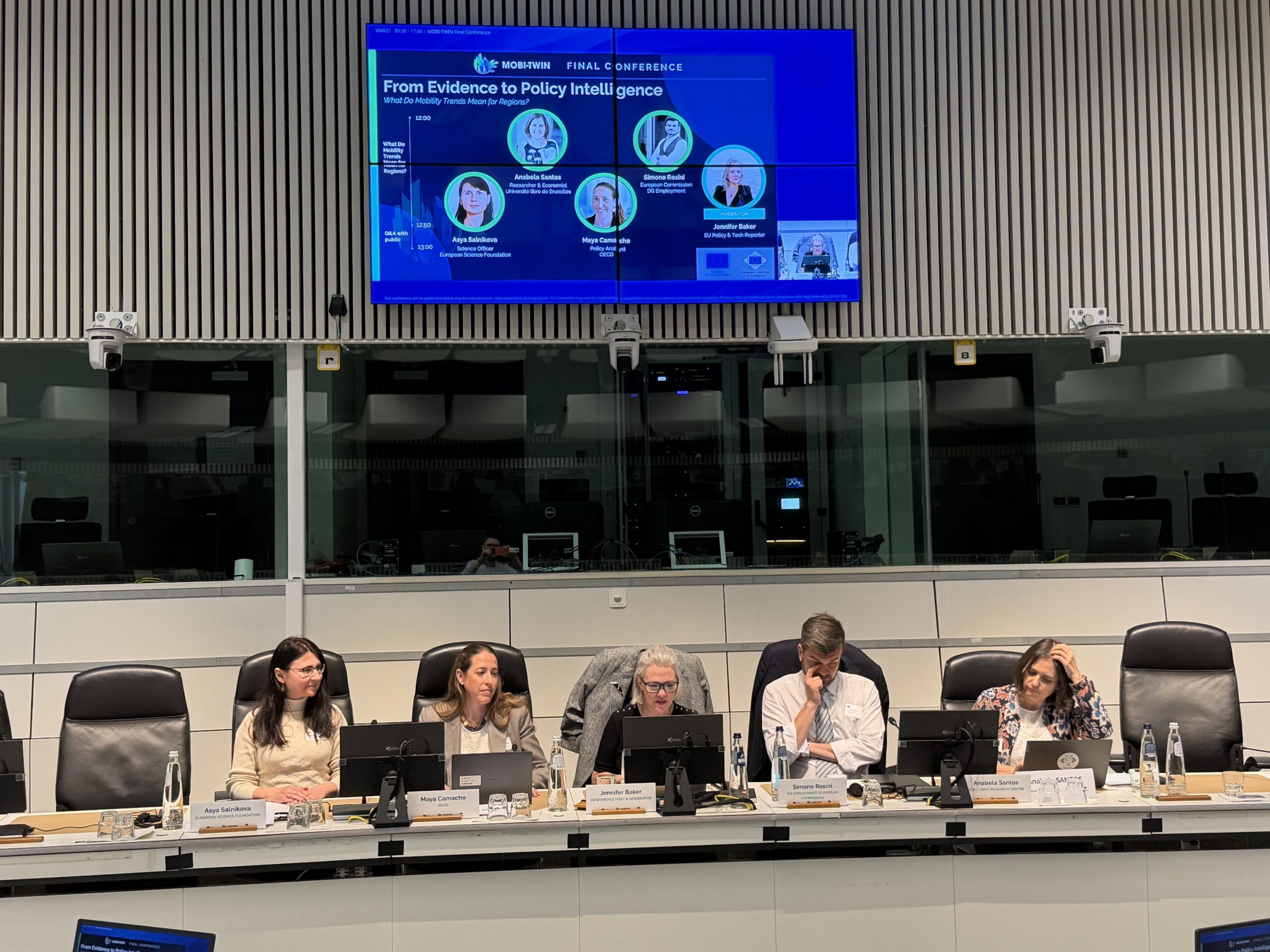
From Evidence to Policy Intelligence: What Do Mobility Trends Mean for Regions?
Research can tell us what’s happening. But what should we do about it? This panel brought together experts from the European Commission, the OECD, the Joint Research Centre, and the European Science Foundation to debate what mobility trends really mean for policymakers and whether the EU’s current tools are up to the challenge.
  • ModeratorJennifer Baker — EU policy and tech reporter
  • PanellistAsya Salnikova — Science Officer at European Science Foundation
  • PanellistAnabela Santos — Researcher & Economist, Université libre de Bruxelles
  • PanellistMaya Camacho — Policy Analyst in the Regional Policy and Attractiveness Unit, OECD
  • PanellistSimone Rosini — European Commission, Directorate General for Employment, Social Affairs and Inclusion, Fair Green and Digital Transitions, Research Unit

Followed by Q&A with the audience

13:00 – 14:00
Networking Lunch
14:00 – 14:50
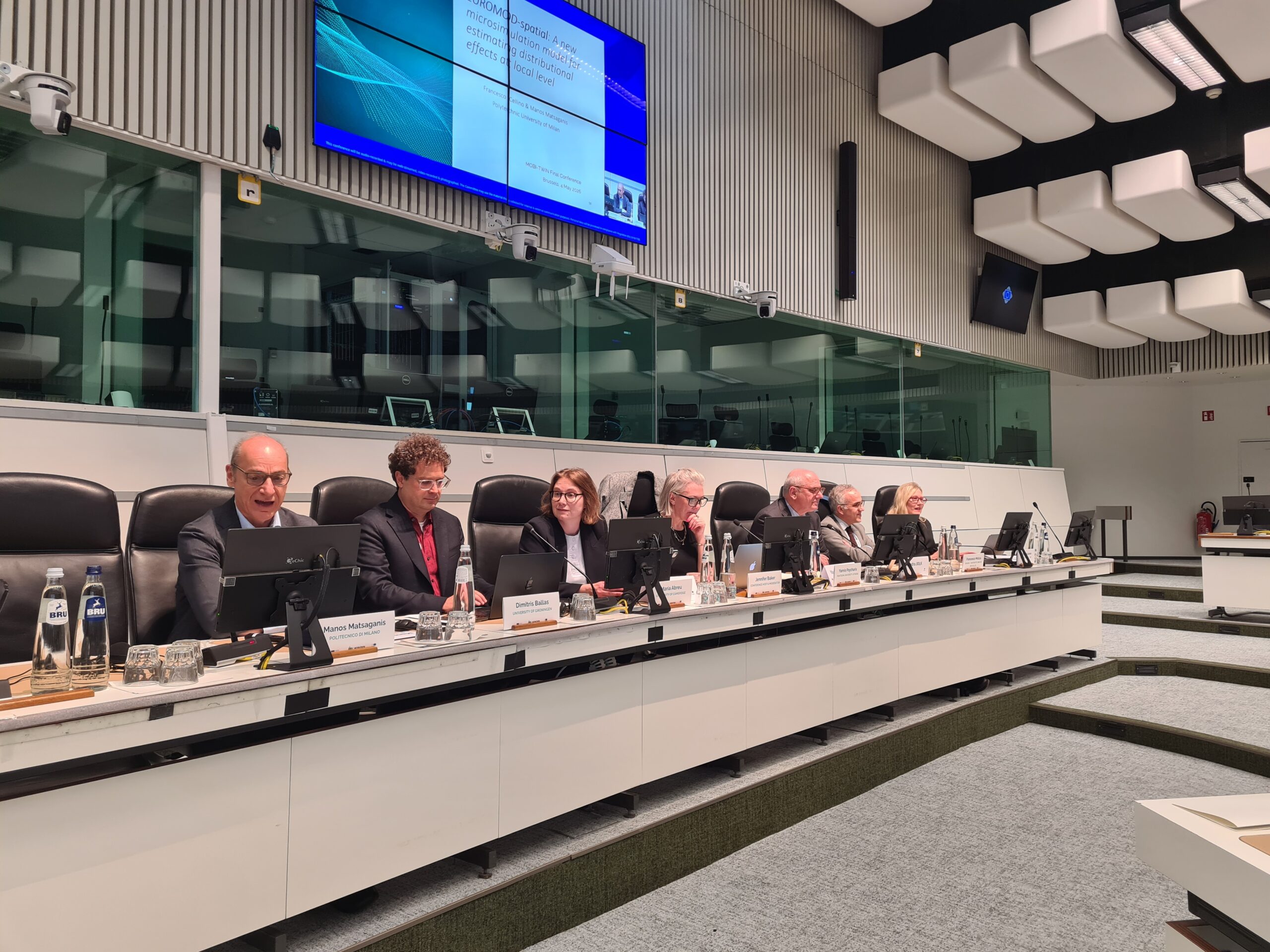
Future Scenarios: How Mobility Will Shape Regional Labour Markets
What happens next? This session took a forward look at how shifting mobility patterns could reshape regions across Europe. Using advanced modelling tools, including microsimulation, agent-based models and EUROMOD, researchers presented scenarios that policymakers can’t afford to ignore, from widening welfare gaps to new opportunities for regional repositioning.
  • Manos Matsaganis — Full professor of Public Finance, Politecnico di Milano
    • EUROMOD as a tool for social welfare impacts
  • Dimitris Ballas — Professor of Economic Geography, University of Groningen
    • Spatial MSM & ABM modelling for future policy scenarios

Followed by Q&A with the audience

14:50 – 15:50
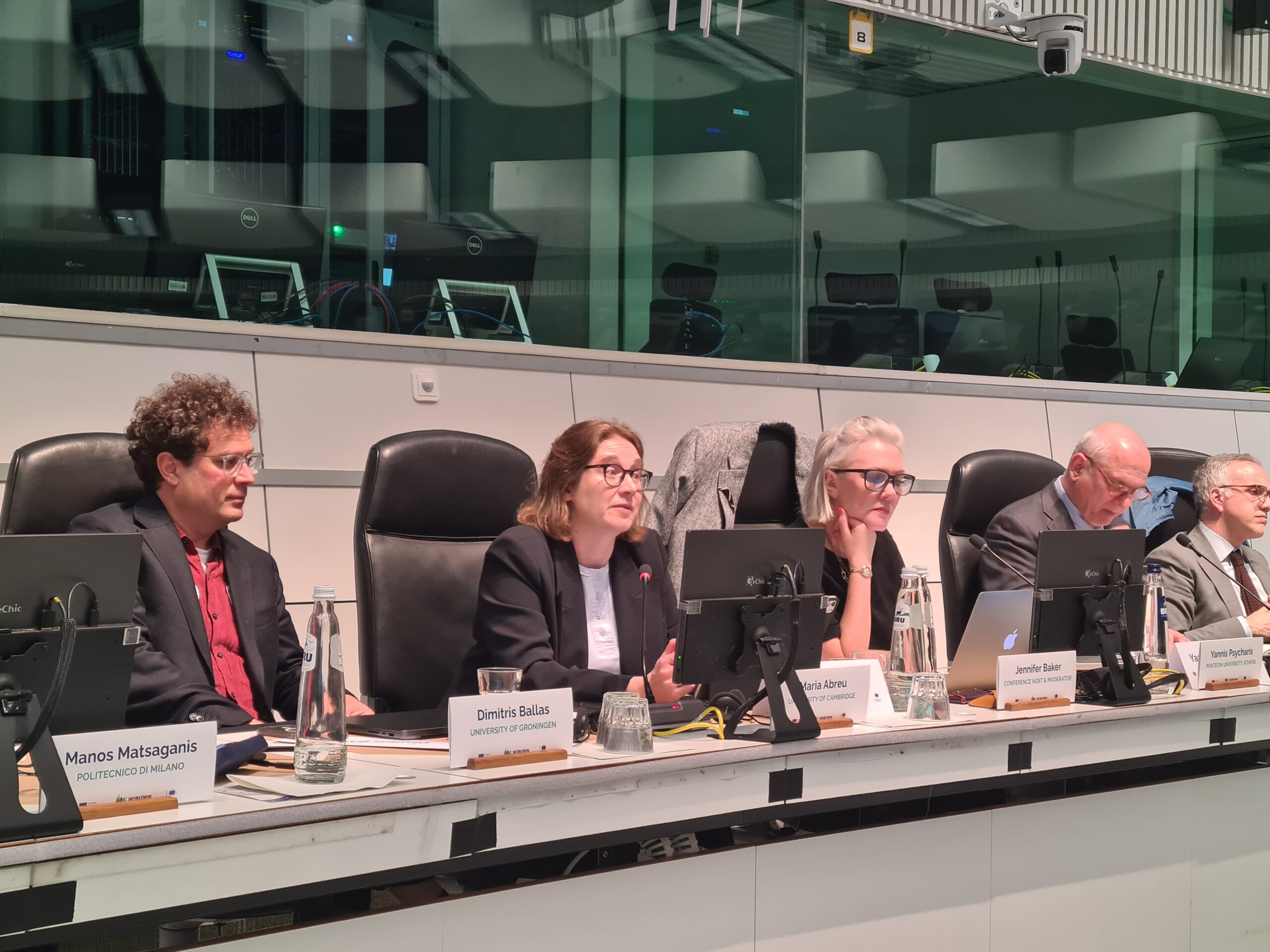
Addressing Challenges in Left-Behind Regions: Policy Responses
Some regions are caught in a difficult cycle: people leave, investment follows, and the gap with prosperous regions widens. But is this inevitable? This panel brought together regional economists, development experts, and policy practitioners to debate what genuinely works, and what needs to change, for the regions at greatest risk of being left behind by the twin transition.
  • ModeratorJennifer Baker — EU policy and tech reporter
  • PanellistYannis Psycharis — Professor of Regional Economic Analysis, Department Economic and Regional Development, Panteion University, Athens (policy briefs)
  • PanellistMaria Abreu — Professor of Economic Geography, University of Cambridge
  • PanellistSandra Jolk — Regional Development and Multi-level Governance Division, OECD Centre for Entrepreneurship, SMEs, Regions and Cities (CFE)
  • PanellistTaina Tukiainen — Member of the Mission Board for Climate Adaptation, visiting Scientist at the JRC
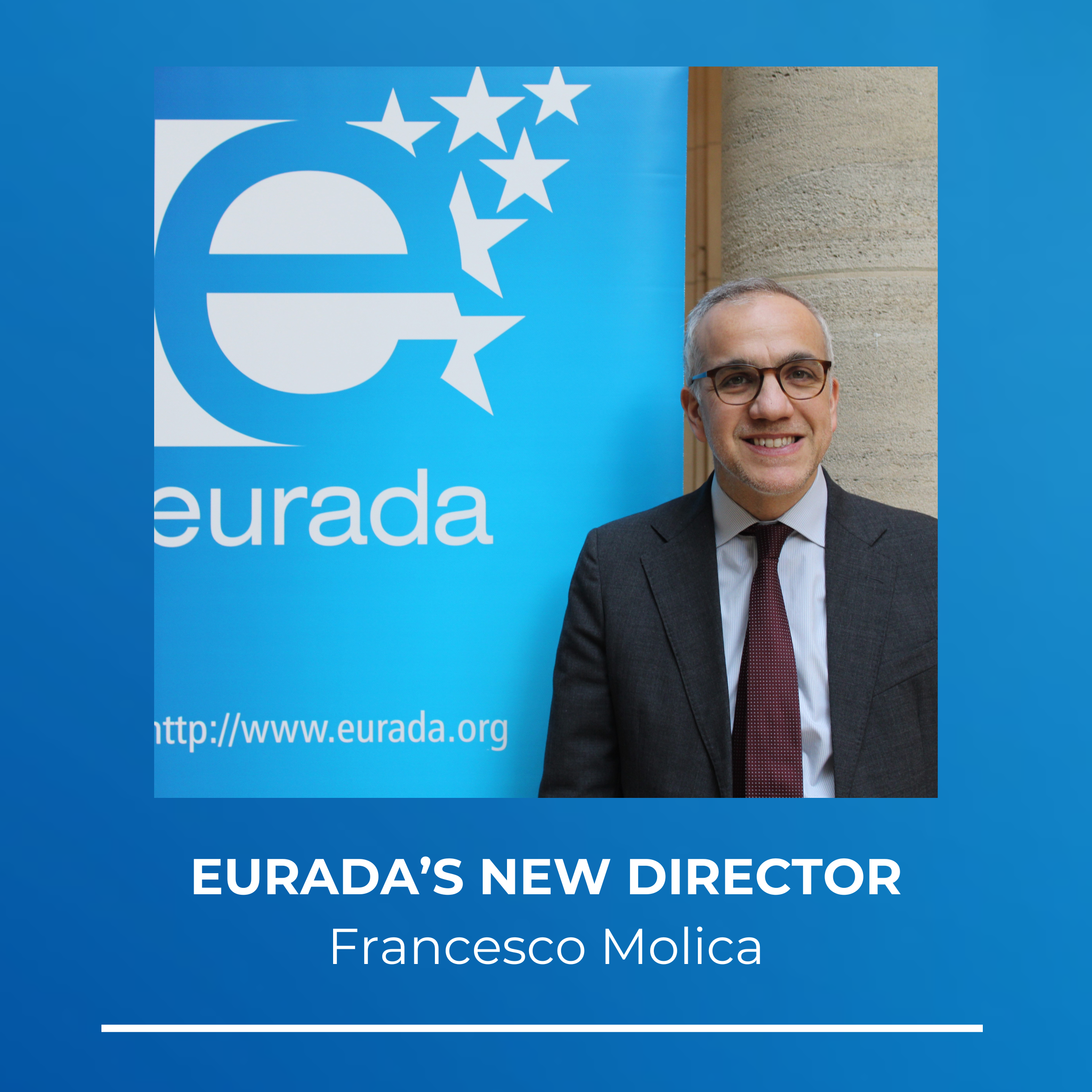
  • PanellistFrancesco Molica — Director at EURADA
15:50 – 16:10
Coffee Break
16:10 – 16:40
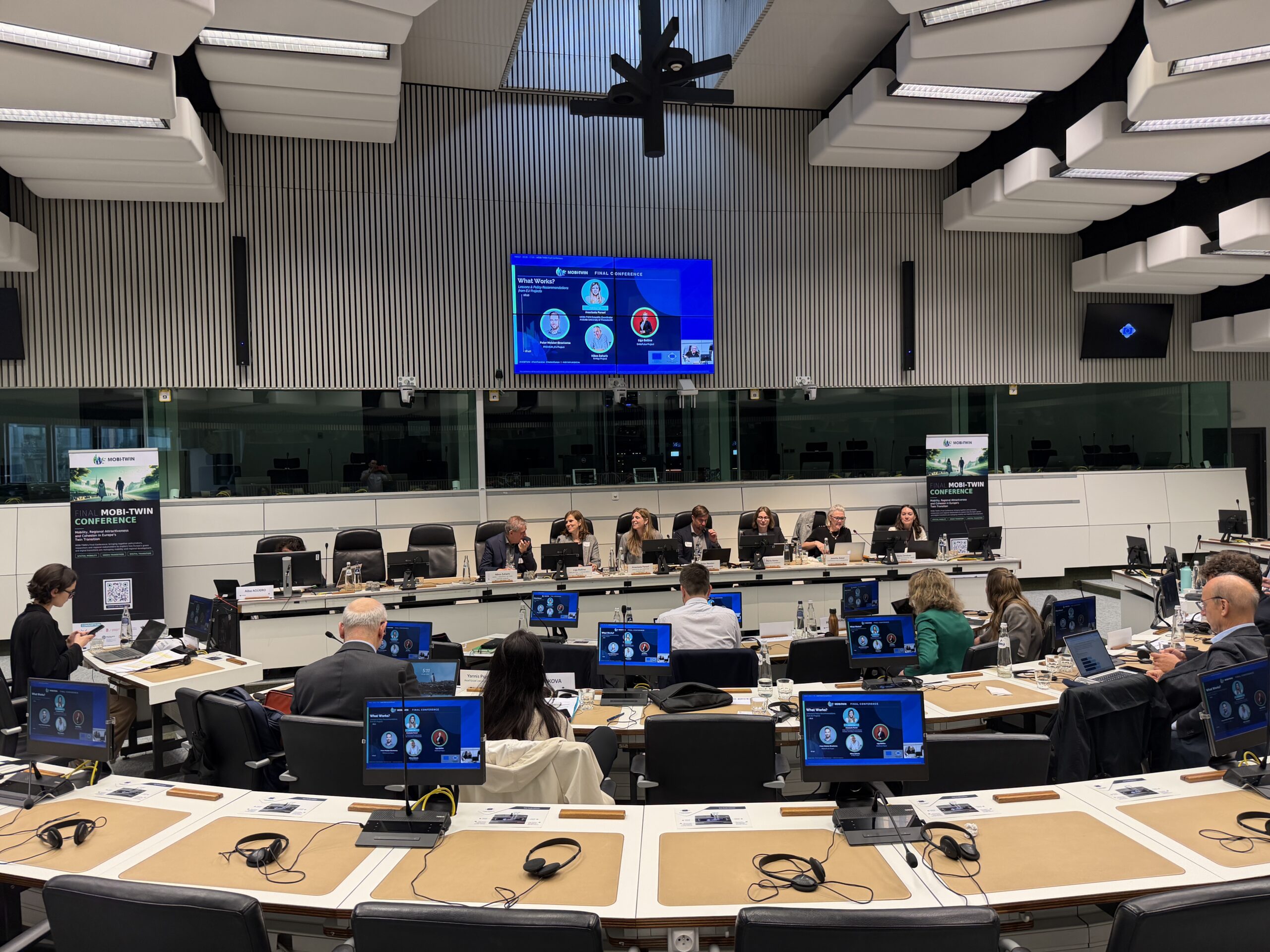
What Works? Lessons and Policy Recommendations from EU Projects
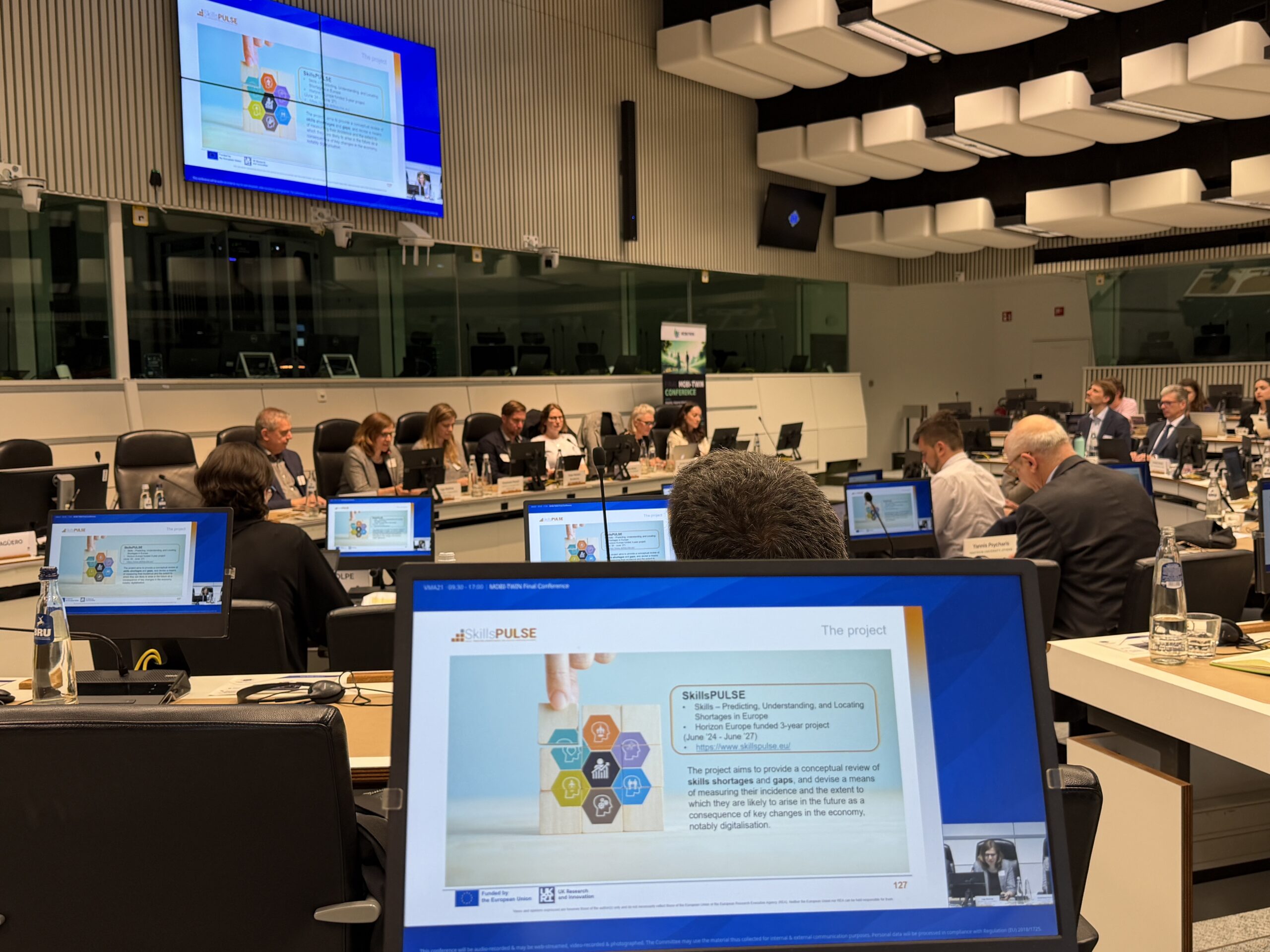
MOBI-TWIN is not alone. This session brought together three complementary Horizon Europe projects – PREMIUM_EU, R-Map, and SkillsPulse – to compare notes, share lessons learned, and build a collective evidence base for smarter EU policy on mobility, skills, and regional development.
  • ModeratorAnastasia Panori — MOBI-TWIN Scientific Coordinator, Assistant Professor on Regional Analysis and Policy, Aristotle University of Thessaloniki
  • Peter Meister-Broekema — PREMIUM_EU project
  • Nikos Zaharis — R-Map project
  • Liga Baltina — SkillsPulse project
16:40
Closing Keynote: Spatial Mobility and the Future of Cohesion Policy
How should Europe rethink cohesion policy for a world where people, skills, and opportunities are unevenly distributed, and increasingly mobile? This closing keynote brought the day’s conversations together into a forward-looking reflection on what the evidence means for the future of EU cohesion policy, and what it will take to build a more balanced and resilient Europe.
  • KeynoteMaria Abreu — MOBI-TWIN Advisory Board, Professor of Economic Geography, University of Cambridge
16:55
Closing Remarks
A moment to look back on the day’s conversations, highlight the key takeaways, and look ahead to what comes next for the MOBI-TWIN project and its policy legacy.
  • Giulia Zendron — MOBI-TWIN Coordinator, Senior Project Manager at White Research

Our Speakers

Researchers, policymakers and experts who shaped the conversation on mobility and regional development.


Giulia Zendron
Giulia Zendron
MOBI-TWIN Coordinator / White Research
Senior Project Manager and Head of the Cross-cutting Innovation Unit at White Research Brussels. Coordinator of the Horizon Europe MOBI-TWIN project.
Simone Rosini
Simone Rosini
DG Employment, European Commission
Policy Officer at the Directorate-General for Employment, Social Affairs and Inclusion of the European Commission, working on employment policies and labour market analysis.
Jennifer Baker
Jennifer Baker
Conference Host & Moderator
Brussels-based EU policy and technology journalist with over 20 years of experience. Regular contributor to BBC Radio and Euronews, specialising in European technology policy and legislation.
Maria Abreu
Maria Abreu
University of Cambridge
Professor of Economic Geography at Cambridge. Regional economist working on labour markets, migration and productivity. Chair of the Regional Science Association International (British & Irish Section).
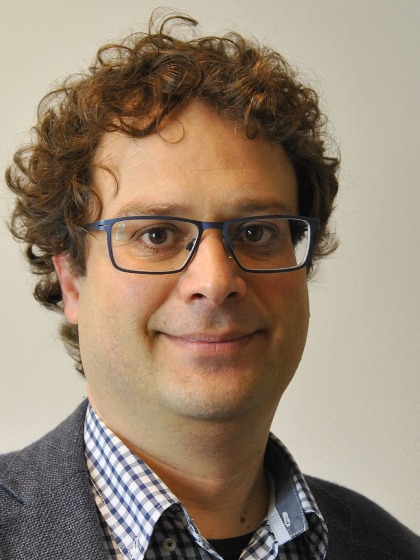
Dimitris Ballas
Dimitris Ballas
University of Groningen
Full Professor of Economic Geography at the University of Groningen. Expert in spatial inequalities, microsimulation modelling and the geography of well-being.
Liga Baltina
Liga Baltina
SkillsPULSE / Fondazione G. Brodolini
Head of Labour Market & Skills Research at Fondazione Giacomo Brodolini and Coordinator of the SkillsPULSE Horizon Europe project on measuring skill shortages across Europe.
Maya Camacho
Maya Camacho
OECD
Policy Analyst in the Regional Policy and Attractiveness Unit at the OECD. Over 15 years of experience in public policy, territorial development and multi-level governance.
Olle Järv
Olle Järv
University of Helsinki
Researcher at the University of Helsinki specialising in integrated mobility datasets, spatial mobility mapping and data-driven approaches to understanding regional dynamics.
Manos Matsaganis
Manos Matsaganis
Politecnico di Milano
Full Professor of Public Finance at Politecnico di Milano. Expert in welfare economics, social policy and the political economy of austerity in Southern Europe.
Peter Meister-Broekema
PREMIUM_EU Project
Representative of the Horizon Europe PREMIUM_EU project, contributing cross-project insights on mobility, labour markets and regional development in the European context.
Francesco Molica
Francesco Molica
EURADA / Université libre de Bruxelles
Director of EURADA and PhD researcher at Université libre de Bruxelles. Extensive experience in regional policy, EU cohesion policy and innovation. Former JRC, DG REGIO and CPMR official.
Anastasia Panori
Anastasia Panori
Aristotle University of Thessaloniki
Assistant Professor in Spatial Planning and Development. Expert in economic and regional development with extensive experience in Horizon-funded research and European Commission consultancy.
Yannis Psycharis
Yannis Psycharis
Panteion University, Athens
Professor of Regional Economic Analysis at Panteion University and Director of the Regional Development Institute. Vice-President of ERSA and expert in regional economics and economic geography.
Vicente Royuela
Vicente Royuela
University of Barcelona
Full Professor of Applied Economics and MOBI-TWIN Team Leader at UB. Expert in regional science, spatial mobility and labour markets. Editor in Chief of Global Challenges and Regional Science.
Sandra Jolk
Sandra Jolk
OECD
Regional Development and Multi-level Governance Division, OECD Centre for Entrepreneurship, SMEs, Regions and Cities (CFE).
Asya Salnikova
Asya Salnikova
European Science Foundation
Science Officer at the European Science Foundation with a PhD in International Law (Strasbourg). Expert in international research collaborations, citizen science and Open Science initiatives.
Anabela Santos
Anabela Santos
ULB / Joint Research Centre
Associate Researcher at the Université libre de Bruxelles and former Team Leader at the European Commission’s Joint Research Centre. Economist specialising in the monitoring, evaluation and governance of EU funds, working at the intersection of data analysis, regional development and public policy.
Thomas Wobben
Thomas Wobben
European Committee of the Regions
Director of Legislative Works at the European Committee of the Regions.
Taina Tukiainen
Taina Tukiainen
EU Mission Board / JRC
Member of the EU Mission Board for Climate Adaptation and Visiting Scientist at the Joint Research Centre. Expert in regional attractiveness and innovation ecosystems.
Nikos Zaharis
Nikos Zaharis
SEERC / University of York Europe Campus
Director of SEERC with 30+ years of experience in innovation policy, regional development and entrepreneurship. Coordinator of the R-Map project and member of the MOBI-TWIN Advisory Board.

The MOBI-TWIN Consortium

MOBI-TWIN is a Horizon Europe project (HORIZON-CL2-2022-TRANSFORMATIONS-01) exploring how Europe’s twin transition reshapes spatial mobility and regional attractiveness. The project brings together 9 partners across Europe.
European Committee of the Regions

Disclaimer: This event is hosted at the European Committee of the Regions. The views expressed during the conference are those of the speakers and do not necessarily reflect the official position of the European Committee of the Regions. The European Committee of the Regions is not responsible for the content of this event.

MOBI-TWIN has received funding from the European Union’s Horizon Europe research and innovation programme under grant agreement No. 101094402.

CoR Data Protection Policy