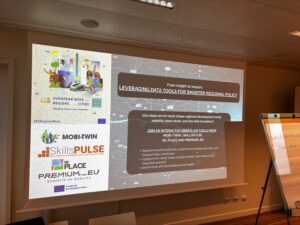

The European territorial landscape is undergoing a profound transformation driven by digital, green, demographic, and social shifts. To support evidence-based, place-sensitive policies, the MOBI-TWIN project has officially released Policy Brief #2: “Regional attractiveness and the twin transition: A new typology of EU regions”.
The European territorial landscape is undergoing a profound transformation driven by digital, green, demographic, and social shifts. To support evidence-based, place-sensitive policies, the MOBI-TWIN project has officially released Policy Brief #2: “Regional attractiveness and the twin transition: A new typology of EU regions”.
The Regional Attractiveness Index (RAI)
At the heart of this report is the RAI, an analytical framework that integrates over 40 indicators from Eurostat, JRC, and other regional databases to assess a region’s capacity to attract and retain talent. The index is built on three essential pillars:
- Traditional Pillar: Focuses on GDP per capita, employment rates, accessibility, and demographic potential.
- Green Pillar: Reflects renewable energy use, circular-economy performance, and overall environmental quality.
- Digital Pillar: Measures ICT infrastructure, R&D intensity, and human capital.
A New Typology: The 6 Clusters of EU Regions
The report introduces a data-driven classification of EU regions, revealing how different territories are positioned within the twin transition. Our analysis identifies six distinct clusters:
- Metropolitan Leaders: High-tech hubs with strong digital and green pillars (e.g., Paris, Berlin, Stockholm).
- Balanced Innovators: Regions showing steady progress with stable governance and infrastructure (e.g., Salzburg, Etelä-Suomi).
- Industrial Heartlands in Transformation: Manufacturing strongholds facing digital and green lagging (e.g., Köln, Piemonte).
- Economies in Structural Transition: Modest but improving regions benefiting from quality of life (e.g., Cataluña, Lombardia).
- Cohesion Regions with Catch-Up Potential: Young, affordable regions with emerging innovation capacity (e.g., regions in Poland, Hungary, and Slovakia).
- Structurally Lagging and Peripheral Regions: Territories rich in natural assets but facing demographic risks and limited digital access (e.g., rural Greece, southern Italy, Bulgaria).
Key Takeaway for Policy Makers
There is a strong correlation between RAI scores and intra-EU mobility flows. Regions with high digital and green attractiveness effectively retain and attract skilled workers, while those with low scores face net out-migration and decline.
The RAI typology serves as a diagnostic tool for EU Cohesion Policy, guiding the allocation of ERDF and ESF+ funds and supporting the Just Transition Mechanism based on real structural vulnerabilities.
“Regional attractiveness is a cornerstone of Europe’s resilience. By understanding where regions stand in their transformation, we can design interventions that ensure no region is left behind.”
📖 Download the full Policy Brief #2 here!