
MOBI-TWIN Final Conference Brings Together 300 Participants to Address Europe’s Territorial Mobility Challenges
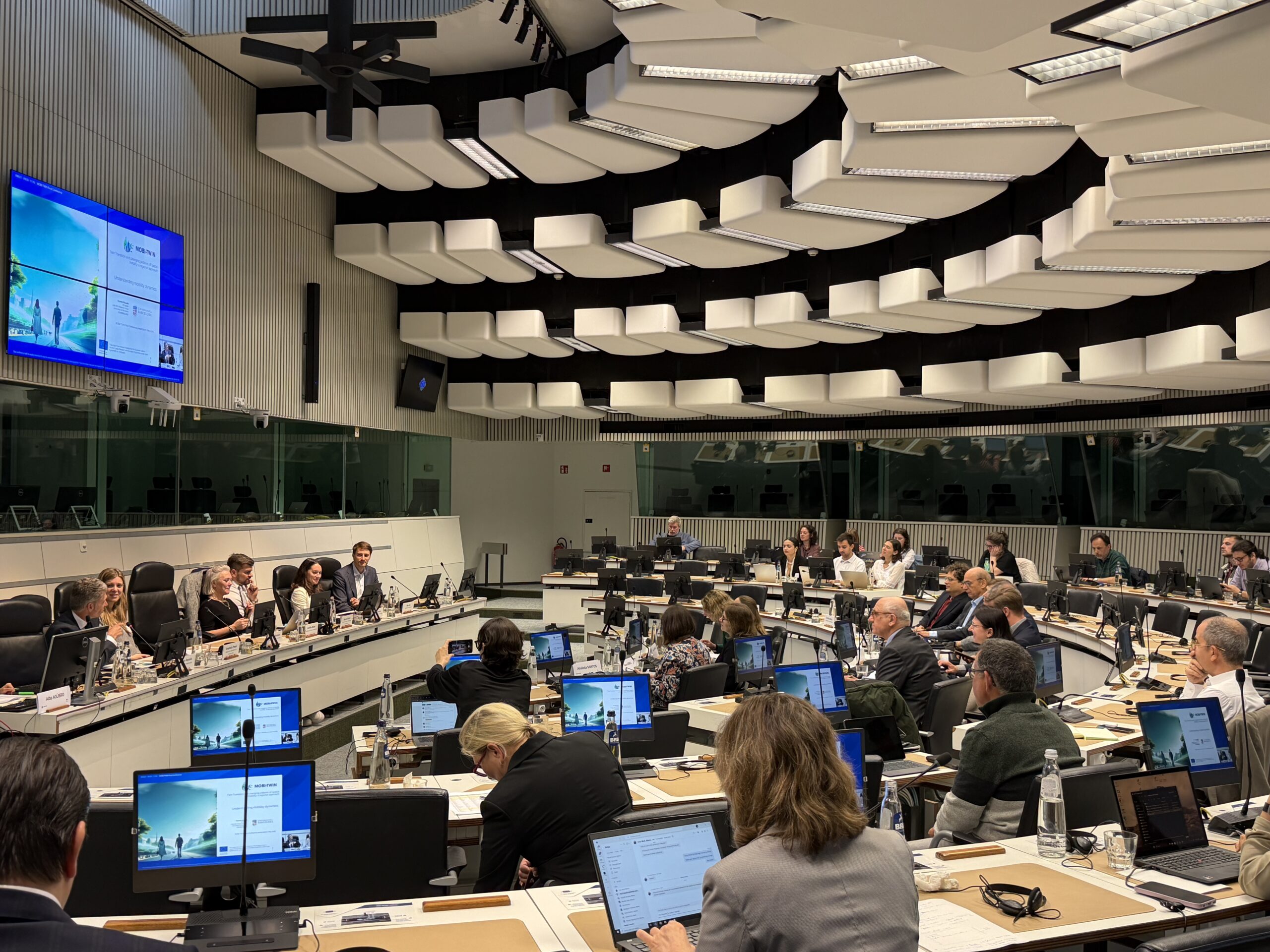
On 4 May 2026, the MOBI-TWIN consortium held its Final Conference at the European Committee of the Regions in Brussels, bringing together over 100 participants on site and more than 200 joining online to discuss how Europe’s twin green and digital transitions are reshaping spatial mobility across the continent.
Titled “Spatial Mobility and Europe’s Twin Transition: Evidence, Scenarios and Policy”, the full-day event marked the culmination of three years of research under the MOBI-TWIN Horizon Europe project. More than 20 speakers and panellists from universities, the European Commission, the OECD, regional authorities and sister EU projects came together to present findings, debate policy implications and chart a path forward for place-based policymaking in Europe.
A “geographical revolution” at the heart of Europe
A central theme throughout the day was the geographical revolution unfolding across European regions: the digital transition is making location increasingly optional — people can work from a village, a coastal island, anywhere the fibre reaches — while the green transition is making location a matter of destiny, tied to where the wind blows and the sun falls. These two opposing forces are fundamentally reshaping how and where people choose to live, and the conference explored what this means for territorial cohesion.
Key results presented
Among the project’s key outputs showcased at the conference were:
- The Regional Attractiveness Index — a new multidimensional framework covering connectivity, services, green amenities, jobs & skills, housing and trust to understand what makes a place somewhere people choose to stay.
- Integrated mobility datasets — novel methods combining mobile phone data, transport records and survey data to map how people actually move across European regions.
- A Policy Dashboard and series of Policy Briefs — translating research into concrete, actionable recommendations for EU, national and regional decision-makers.
- Future territorial scenarios — forward-looking models exploring how regions may develop under different transition pathways, with particular attention to left-behind places and demographic change.
From evidence to policy
The morning opened with welcome remarks from Thomas Wobben (Director of Legislative Works, European Committee of the Regions) and Simone Rosini (European Commission, DG Employment), followed by a keynote address from MOBI-TWIN Scientific Coordinator Anastasia Panori (Aristotle University of Thessaloniki). Scientific presentations by Olle Järv (University of Helsinki) and Vicente Royuela (University of Barcelona) presented the latest evidence on mobility dynamics and regional attractiveness.
The afternoon featured a rich policy debate on challenges facing left-behind regions and a cross-project session with sister Horizon Europe initiatives — PREMIUM_EU, R-Map and SkillsPulse — highlighting common patterns and complementary approaches. The conference closed with a forward-looking keynote by Maria Abreu (University of Cambridge) on the future of place-based policy in the EU.
Watch the full conference
Missed the event or want to revisit a session? The complete conference recording is available on YouTube, split into four parts covering all keynotes, scientific presentations and policy panels.
Learn more
- Conference page — full programme, speaker bios, photo gallery and recordings
- Policy Briefs — research-backed recommendations for policymakers
- Project website — about MOBI-TWIN, partners and publications