

A New Analytical Foundation for Europe’s Regional Future
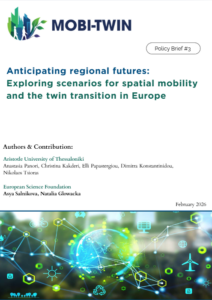
The MOBI-TWIN project has reached a significant milestone with the official publication of its first Policy Brief, titled “Spatial mobility and the twin transition: Understanding the drivers of change in Europe’s regions”. The policy brief establishes the conceptual and analytical foundation for the project’s mission to map how Europe’s simultaneous shift toward a digital and green economy is reshaping the movement of people across the continent. By analyzing these transitions, the project provides vital insights to design more evidence-based and place-sensitive policies.
Beyond Relocation: Redefining Modern Spatial Mobility
The project introduces a modernized framework for spatial mobility that goes beyond permanent relocation to include three primary categories. While long-term mobility remains essential for work and education, the rise of hybrid work and digital nomadism has increased the importance of short-term stays and circular movements, such as weekly commuting and multilocal living. These evolving patterns are fundamentally redefining regional attractiveness, as the geography of opportunity shifts to reflect the new realities of an interconnected Europe.
The “Green Pull”: How Transitions Drive Regional Appeal
Research findings highlight that while economic structure and labor-market opportunities remain powerful, digital and green factors are emerging as critical new dimensions for mobility. Regions offering fast broadband and telework readiness are seeing a positive impact on mobility intentions, even if traditional economic motivations still carry significant weight. Perhaps more strikingly, the “green pull” is becoming a decisive factor; individuals are significantly more likely to move to regions with cleaner air, superior green infrastructure, and visible progress in the green transition, while those reliant on fossil fuels risk further depopulation.
A Heterogeneous Landscape: Diverse Drivers for Diverse Groups
The analysis further reveals that mobility decisions are highly heterogeneous across different demographic groups. For example, women and older cohorts show a higher responsiveness to green and lifestyle factors, whereas men and younger populations tend to prioritize digital infrastructure and innovation. This diversity in drivers suggests that a “one-size-fits-all” approach is no longer sufficient for regional planning, especially as attractive innovation hubs continue to pull talent away from peripheral areas, reinforcing existing core-periphery imbalances.
A Strategic Vision for Transition Governance
To ensure a resilient territorial future, the Policy Brief emphasizes that mobility must be reframed as a core governance challenge rather than a side effect of economic change. The project recommends integrating spatial mobility indicators into central EU frameworks like the Cohesion Policy and the Just Transition Mechanism to support regions facing “dual disadvantages” in both population loss and transition readiness. Among the key recommendations is the establishment of a European Observatory on Regional Mobility and Attractiveness, which would provide a shared platform for continuous assessment and help ensure that no region is left behind in the age of the twin transition.
Read and download the 1st Policy Brief here!